
01
Being able to follow what one owns
An asset may exist. A right of ownership may be established. Yet it must still be possible, over time, to maintain the link between the asset, its owner and the events that mark its existence.
That is the role of traceability.
At Jaspall Swiss, traceability is not a simple accumulation of documents or data. It answers a more fundamental question:
can we follow the history of what we own and understand how we arrived at the present situation?
Traceability is therefore the third pillar of our philosophy.
02
The memory of wealth
Every ownership relationship needs a memory.
An asset passes through time. It may be acquired, transferred, transformed, managed by different parties or become subject to new rights.
Without documentary continuity, part of this history can gradually disappear.
Traceability seeks precisely to preserve this continuity.
It connects what exists today with what existed yesterday and preserves, as far as possible, the elements needed to understand the transformations between the two.
In this sense, traceability is the organised memory of an asset.
Traceability is the organised memory of an asset.
03
From trace to proof
Human beings have always sought to preserve traces of what they own and transmit.
Boundary markers, deeds, registers, land records, inventories, certificates and identification numbers: the media have changed, but the function remains.
The aim is to create continuity clear enough for a third party to understand the relationship between a person, a right and an asset.
An isolated piece of information is not necessarily proof.
The quality of traceability depends on the coherence, origin, preservation and legal or organisational framework of the elements that compose it.
Tracing does not simply mean accumulating information.
Tracing means organising continuity.
04
When distance increases
The modern economy has made it possible to hold assets and rights located around the world with a facility that would once have been unimaginable.
This evolution creates considerable possibilities, but it can also increase the distance between the investor and the economic reality behind the investment.
In financial markets, transactions are widely recorded and subject to sophisticated traceability mechanisms.
For the final investor, however, understanding the path from a security to the underlying economic asset can become much more complex.
Companies, funds, legal vehicles, depositaries, intermediaries, claims and several layers of participation may stand between the two.
The investor generally knows which security he holds.
It may be much harder to answer another question immediately:
to which precise economic reality does this security connect me?
05
Traceability does not mean simplicity
A tangible asset does not escape this issue.
The mere fact that an asset physically exists is not enough to make it properly traceable.
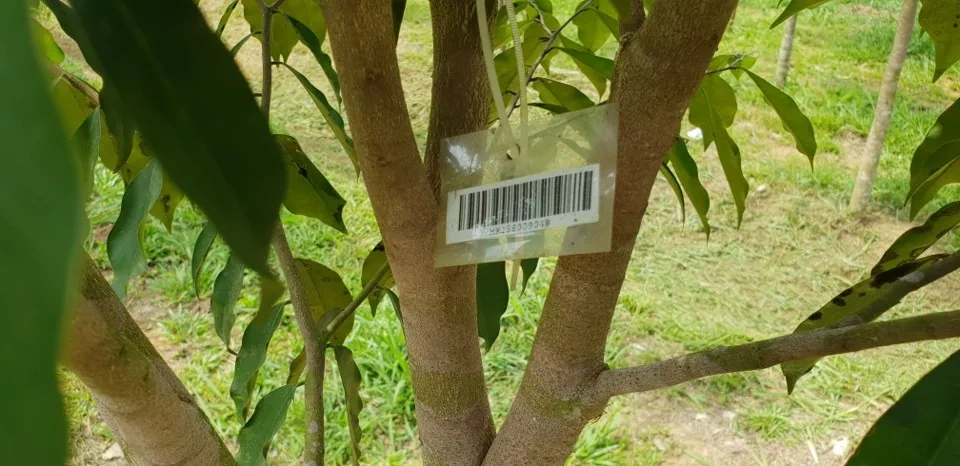
A tree may exist without its owner being able to identify it easily.
A document may exist without making it possible to find the asset to which it relates.
A number may be assigned without anyone knowing how it was created or how continuity is ensured.
Traceability therefore requires organisation.
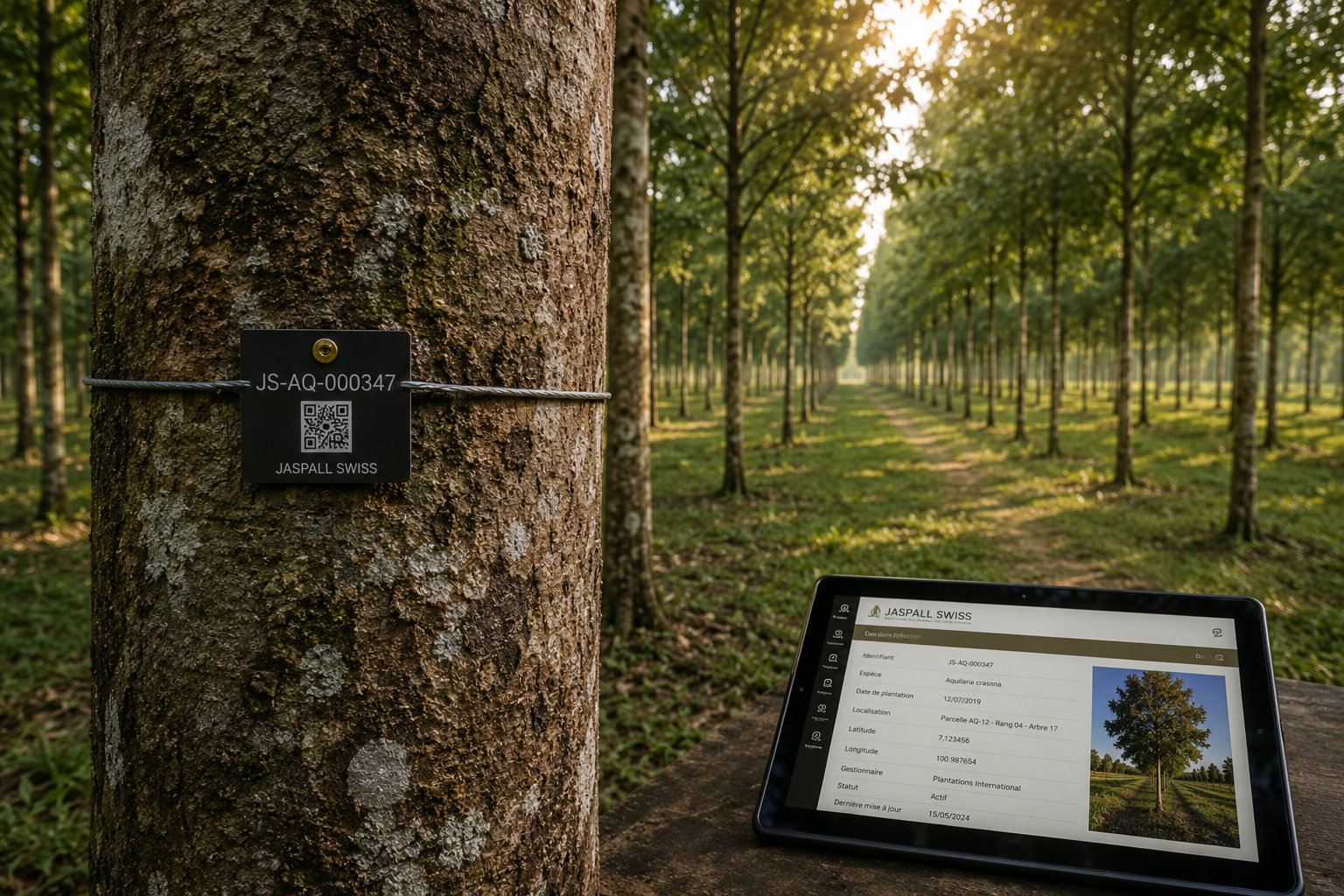
It means maintaining a coherent relationship between the physical asset, its identification, the rights attached to it, the corresponding documents and the stages of its path.
06
Identifying without confusing
This distinction is particularly important in agroforestry.
The land, the tree, the rights relating to it, its management and the products it may generate are different realities.
Confusing them would create the opposite of the traceability sought.
A rigorous approach should distinguish as far as possible:
what is identified,
what is owned,
what is managed,
and what is produced.
Traceability then becomes the thread that links these elements without confusing them.
07
A chain is worth its continuity
Traceability is never a single event.
It is not acquired simply because a document was issued at the beginning of an operation.
It must accompany the asset over time.
A change of manager, a transfer, a change in situation or an operation concerning the asset should not unnecessarily break the continuity of its documentary history.
A chain of traceability is therefore less a photograph than a narrative.
Its value rests on the continuity between its different stages.
Quality traceability must also remain understandable. A large quantity of data does not necessarily guarantee better understanding if nobody can easily establish the relationships between them.
Its value rests on the continuity between its different stages.
08
Digital technology: tool, not reality
Digital technologies have greatly improved our ability to record, search and transmit information.
They are valuable tools for traceability.
But they must not be confused with what they represent.
A database describing a tree is not the tree.
An identification number is not ownership.
A computer file is not the history it seeks to preserve.
Digital technology gains its value when it makes it possible to document durably a reality that exists outside it.
This distinction directly echoes our philosophy of the tangible: technology must serve reality, not make us forget that it is only a representation of it.
09
From transparency to understanding
Transparency and traceability are often associated, but they are not exactly synonymous.
One can make a large amount of information available and still remain difficult to understand.
True traceability must allow access to relevant information, but also make its sequence and relationships intelligible.
For the owner of an asset, the objective is not to hold as many documents as possible.
It is to find the right elements, at the right time, and understand what they establish.
10
Reducing distance
This reflection is especially important for unlisted assets or directly held assets.
In private equity, private assets and the real economy, information is not necessarily produced and distributed in the same way as on a listed market.
The quality of documentation, reporting and the information chain therefore becomes particularly important.
Proximity to an asset does not automatically guarantee transparency.
It creates an additional requirement:
if we choose to move closer to the real asset, we must also be able to understand better what happens to it.
This is the requirement carried by traceability.
11
Three principles, one logic
The three pillars of Jaspall Swiss are not independent.
They form a logical sequence.
Tangible: starting from something that truly exists.
Ownership: determining precisely which rights apply to that reality and to whom they belong.
Traceability: preserving over time the link between the asset, the rights attached to it and the events that make up its history.
Each is incomplete without the others.
A tangible asset for which nobody can establish rights creates an ownership problem.
Perfectly established ownership of an asset that can no longer be identified creates a traceability problem.
And even highly sophisticated traceability can never replace the existence of what it claims to document.
12
Preserving the thread
Our third principle can therefore be summarised as follows:
knowing what exists, knowing what one owns and being able to preserve the thread over time.
Traceability does not remove risk.
It guarantees neither the future value of an asset nor its performance.
It brings something different: the possibility of preserving an intelligible continuity between a reality, the rights that apply to it and its history.
After choosing to start from reality and clearly establish ownership, Jaspall Swiss considers this continuity an essential condition for wealth that one wishes to understand, follow and transmit.